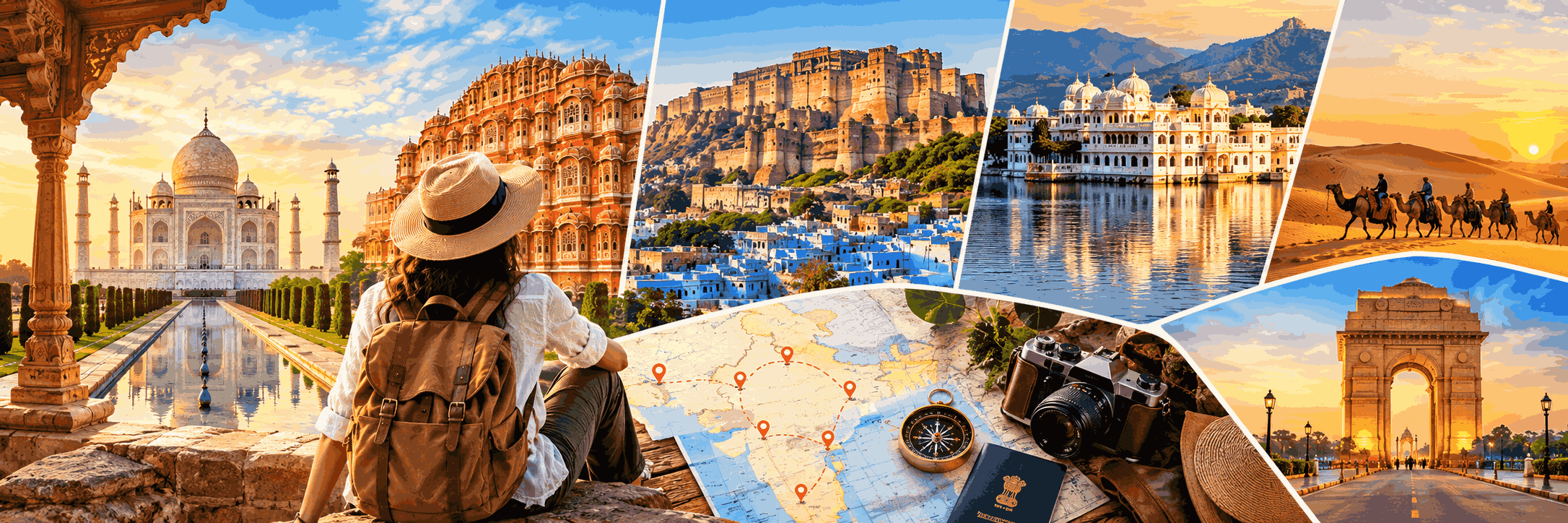
Planning your first trip to India can feel overwhelming.
India is enormous, culturally diverse and filled with historic cities, ancient monuments, colorful markets, royal palaces, spiritual places and unforgettable food experiences. With so many destinations to choose from, one of the biggest challenges for a first-time visitor is deciding where to go and how to fit everything into a limited vacation.
A well-planned 10 days India itinerary can give you a fascinating introduction to North India without trying to cover the entire country in a single trip.
For first-time international travelers, one practical approach is to focus on Delhi, Agra and Rajasthan, combining India's major historic landmarks with royal architecture, local culture and different landscapes.
This guide presents a balanced route:
Delhi → Agra → Jaipur → Jodhpur → Udaipur
The route combines famous landmarks with cultural experiences and gives you an opportunity to experience several different sides of India.
If you are looking for a customized Rajasthan experience, you can also explore the Rajasthan Tour Packages offered by India Heritage Journey.
10 Days India Itinerary at a Glance
Day | Destination | Main Experiences |
Day 1 | Delhi | Arrival, Old Delhi and local exploration |
Day 2 | Delhi | Historic monuments and cultural sightseeing |
Day 3 | Agra | Taj Mahal and Agra Fort |
Day 4 | Jaipur | Arrival and evening exploration |
Day 5 | Jaipur | Amber Fort, City Palace and local markets |
Day 6 | Jodhpur | Travel to Jodhpur and Blue City |
Day 7 | Jodhpur | Mehrangarh Fort and heritage sightseeing |
Day 8 | Udaipur | Travel to Udaipur and Lake Pichola |
Day 9 | Udaipur | City Palace, temples and local experiences |
Day 10 | Udaipur/Delhi | Final sightseeing and departure |
This route is particularly suitable for travelers who want to experience history, architecture, culture and Rajasthan's royal heritage during their first visit.
Day 1: Arrive in Delhi
Your journey begins in Delhi, India's capital and one of the country's most interesting cities for first-time visitors.
After arriving at Indira Gandhi International Airport, check into your hotel and give yourself some time to recover from your international flight.
There is no need to pack your first day with sightseeing.
India can feel very different from what international travelers are accustomed to, especially because of the traffic, sounds, crowds, food and pace of daily life.
Use your first day to settle in.
What you can do on Day 1
Depending on your arrival time, you could explore:
Connaught Place
India Gate
Lodhi Garden
Humayun's Tomb
Local markets
A traditional Indian restaurant
If you arrive late, simply rest and begin sightseeing the following morning.
Where to stay in Delhi
For a first trip, choose accommodation with convenient access to major sightseeing areas and transportation.
You can consider:
Central Delhi
New Delhi
South Delhi
Areas around Connaught Place
Choose a hotel based on your travel style, budget and transportation requirements rather than choosing accommodation solely because it is inexpensive.
Day 2: Explore Delhi's History and Culture
Start your second day with a proper exploration of Delhi.
The city combines centuries of Indian history with Mughal, colonial and modern influences.
Morning: Old Delhi
Begin with Old Delhi.
Some places worth visiting include:
Jama Masjid
One of the most recognizable historic mosques in Delhi.
Red Fort
A major Mughal-era monument and one of the city's most important historical landmarks.
Chandni Chowk
One of Delhi's most famous market areas, where you can experience busy streets, traditional shops and local food.
Old Delhi can be crowded, but that is also part of the experience.
Afternoon: New Delhi
After exploring Old Delhi, move toward central and New Delhi.
You can visit:
India Gate
Humayun's Tomb
Qutub Minar
Lodhi Garden
You do not necessarily need to visit every attraction.
For a first trip, choose a few places and spend enough time experiencing them instead of rushing from one monument to another.
Evening
End your Delhi day with a traditional Indian dinner.
You can try dishes such as:
Butter chicken
Dal
Paneer dishes
Biryani
Roti or naan
Indian desserts
Vegetarian travelers will also find a wide range of options throughout Delhi.
Day 3: Delhi to Agra
On Day 3, travel from Delhi to Agra.
Agra is famous worldwide because it is home to the Taj Mahal.
For many international visitors, seeing the Taj Mahal is one of the main reasons for including Agra in their first India trip.
Visit the Taj Mahal
The Taj Mahal is India's most internationally recognized monument and a UNESCO World Heritage Site.
Try to allow enough time to explore the complex rather than treating it as a quick photo stop.
Pay attention to:
The marble architecture
Decorative details
Gardens
Symmetry
Changing light during the day
The monument can become busy, particularly during popular travel periods, so planning your visit carefully is worthwhile.
Visit Agra Fort
After the Taj Mahal, explore Agra Fort.
The fort provides another perspective on Mughal history and architecture.
If you have additional time, you can also explore other parts of Agra or enjoy a relaxed evening.
Overnight in Agra
For this route, spending a night in Agra can make the journey more comfortable than trying to return to Delhi immediately.
Day 4: Agra to Jaipur
After breakfast, continue toward Jaipur, the capital of Rajasthan.
This is where your journey starts moving deeper into India's royal heritage.
Jaipur is popularly known as the Pink City and is famous for its forts, palaces, bazaars, jewelry, handicrafts and traditional architecture.
Once you arrive, check into your hotel and keep the rest of the day relatively relaxed.
What to do in Jaipur on Day 4
Depending on your arrival time, visit:
Hawa Mahal
City Palace area
Johari Bazaar
Local handicraft shops
Traditional restaurants
Hawa Mahal is particularly attractive around the late afternoon and evening when the surrounding streets become lively.
Experience Jaipur beyond monuments
Do not spend your entire Jaipur visit only inside monuments.
Walk through local markets.
Look at traditional textiles.
Explore handicrafts.
Try Rajasthani food.
Talk to local artisans.
These smaller experiences can make your trip feel much more personal.
Day 5: Full-Day Jaipur Exploration
Day 5 is dedicated to Jaipur.
Amber Fort
Begin with Amber Fort, one of Jaipur's most important historic attractions.
The fort is known for its architecture, courtyards, gates and views of the surrounding landscape.
Allow enough time to explore rather than rushing through the complex.
Amber Fort
Begin with Amber Fort, one of Jaipur's most important historic attractions.
The fort is known for its architecture, courtyards, gates and views of the surrounding landscape.
Allow enough time to explore rather than rushing through the complex.
City Palace
Next, visit the City Palace.
The complex offers insight into Jaipur's royal history and includes courtyards, buildings, decorative details and museum collections.
Jantar Mantar
If your schedule allows, visit Jantar Mantar, the historic astronomical observatory located near the City Palace.
Hawa Mahal
If you did not properly explore Hawa Mahal on Day 4, return during your Jaipur sightseeing day.
Jaipur markets
Finish your day with some shopping.
Popular items include:
Block-printed textiles
Jewelry
Handicrafts
Blue pottery
Traditional clothing
Leather products
If you enjoy shopping, Jaipur can easily take up several hours.
Day 6: Jaipur to Jodhpur
On Day 6, continue to Jodhpur.
Jodhpur is known as the Blue City because of the blue-painted houses surrounding parts of the old city.
The city has a very different atmosphere from Jaipur.
After checking into your hotel, spend some time exploring the old city.
Explore the Blue City
Walk through the narrow streets around the old city and discover:
Local shops
Traditional houses
Small cafes
Handicraft stores
Local markets
One of the best parts of Jodhpur is simply walking through the historic neighborhoods.
Clock Tower Market
The area around the Clock Tower is a popular place to experience the local market atmosphere.
You can shop for:
Spices
Textiles
Handicrafts
Traditional clothing
Local snacks
Day 7: Discover Jodhpur's Royal Heritage
Day 7 is dedicated to Jodhpur's historic attractions.
Mehrangarh Fort
Start with Mehrangarh Fort.
The fort dominates the city and is one of the defining landmarks of Jodhpur.
Inside, visitors can explore historic courtyards, palaces, collections and architectural details.
The elevated location also provides impressive views over the Blue City.
Jaswant Thada
After Mehrangarh Fort, visit Jaswant Thada, a beautiful marble memorial located nearby.
The peaceful surroundings provide a contrast to the busy city.
Rao Jodha Desert Rock Park
If time permits, visit Rao Jodha Desert Rock Park.
It offers an opportunity to see the rocky landscape around Mehrangarh and understand the natural environment of the region.
Evening in Jodhpur
Spend your final evening enjoying the city's food and atmosphere.
Try local dishes and explore the old city at a relaxed pace.
Day 8: Jodhpur to Udaipur
Now continue to Udaipur, often called the City of Lakes.
The atmosphere changes again.
Jodhpur is dominated by its fort and desert landscape, while Udaipur is known for lakes, palaces, gardens and romantic scenery.
After arriving and checking into your hotel, spend the evening around Lake Pichola.
Lake Pichola
A boat experience on Lake Pichola can be a memorable way to see:
City Palace
Jag Mandir
Lakefront architecture
Udaipur's surrounding hills
Sunset can be particularly atmospheric.
Explore the old city
In the evening, walk around Udaipur's old city.
You will find:
Handicraft shops
Cafes
Traditional restaurants
Small art galleries
Local markets
Day 9: Full-Day Udaipur Exploration
Use Day 9 to explore Udaipur properly.
City Palace
Start with the City Palace, one of the city's most important attractions.
The complex combines architecture, courtyards, balconies, museums and views over Lake Pichola.
Jagdish Temple
Visit Jagdish Temple if you are interested in Indian architecture and religious heritage.
Remember to dress respectfully when visiting religious sites.
Saheliyon-ki-Bari
This historic garden provides a quieter experience away from the busiest parts of the city.
Sajjangarh / Monsoon Palace
If time and conditions allow, consider visiting the Monsoon Palace for panoramic views over Udaipur and the surrounding landscape.
Evening
Keep your final evening relaxed.
Enjoy dinner beside the lake or explore the local streets before preparing for departure.
Day 10: Finish Your India Journey
Your final day depends on your onward flight.
If you have a late departure, you can spend the morning exploring Udaipur or shopping for souvenirs.
If your international flight departs from Delhi, plan your return journey carefully and leave enough time for the domestic connection.
For international travelers, it is generally better to leave a comfortable buffer between domestic and international flights rather than planning a very tight connection.
Your 10-day journey has now taken you through:
Delhi → Agra → Jaipur → Jodhpur → Udaipur
That is a substantial introduction to India's history, architecture and culture without trying to see the entire country at once.
How Many Days Are Enough for India?
India is too large to experience properly in just 10 days.
However, 10 days can work very well for a first trip if you concentrate on one region or a logical route.
The biggest mistake first-time visitors make is trying to include too many destinations.
For example, combining Delhi, Agra, Rajasthan, Kerala, Goa and Varanasi within the same 10-day trip can create a schedule dominated by airports, trains and road journeys.
A better approach is to choose a region and explore it properly.
For travelers interested in history and heritage, Delhi, Agra and Rajasthan make a particularly logical combination.
If you want to explore more destinations, consider extending your vacation to two or three weeks.
You can also explore more destinations through India Heritage Journey's Places to Visit in India guide.
Best Time for a 10-Day India Trip
The best time depends on the region you are visiting.
For a Delhi, Agra and Rajasthan-focused journey, many international travelers prefer the cooler months.
October to March
This period is generally popular for exploring North India because daytime sightseeing can be more comfortable than during the hottest part of the year.
April to June
Temperatures can become very high in parts of North India and Rajasthan.
If traveling during this period, plan sightseeing around the weather and consider comfortable hotels, transport and early-morning sightseeing.
July to September
The monsoon season can bring rain to different parts of India.
However, monsoon travel can also provide a different perspective, especially in destinations where the landscape becomes greener.
Always check current local weather conditions before finalizing your travel dates.
How to Travel Around India During 10 Days
Transportation is one of the most important parts of planning a short India trip.
Private car
For a route involving several Rajasthan destinations, a private car with a driver can offer flexibility.
You can stop along the way, adjust your schedule and avoid dealing with multiple train or bus connections.
This can be especially useful for international travelers who are unfamiliar with local roads and transportation.
Trains
India has an extensive railway network.
Trains can be an excellent way to experience long-distance travel, but schedules, station locations and ticket availability need to be considered when planning a short trip.
Domestic flights
Flights can save substantial travel time when destinations are far apart.
However, remember to account for airport transfers, check-in time and potential delays.
A combination works best
There is no need to use one transportation method for the entire journey.
A customized trip can combine private road travel, trains and domestic flights depending on your route.
If you prefer a private and customized holiday, you can also read the India Heritage Journey guide on how to plan a private India tour.
Is a Private Tour Better for a First Trip to India?
There is no single answer because travel preferences differ.
Independent travel can offer flexibility and may suit travelers who enjoy planning everything themselves.
A private tour can be useful for travelers who prefer:
Pre-arranged transportation
Local guidance
Flexible sightseeing
Help with logistics
Customized hotel choices
A more organized schedule
For international visitors unfamiliar with India, having local support can make the planning process simpler.
The important thing is to choose the travel style that matches your budget, comfort level and interests.
How to Customize This 10-Day Route
The itinerary above is only one possible route.
You can modify it according to your interests.
If you love history
Spend more time in Delhi, Agra and Rajasthan's forts and palaces.
If you love culture
Add village experiences, traditional food, folk music, handicrafts and local markets.
If you prefer luxury
Choose heritage hotels, palace properties, private transportation and personalized experiences.
If you love photography
Allow more time in Jaipur, Jodhpur and Udaipur instead of adding more destinations.
If you want a slower trip
Remove one city.
For example:
Delhi → Agra → Jaipur → Udaipur
can provide a slower experience than trying to visit five major cities.
You can also read the guide on planning a personalized cultural holiday in India.
What Should You Pack for India?
Your packing list will depend on the season and destinations.
For a North India trip, consider packing:
Comfortable walking shoes
Lightweight clothing
A light jacket during cooler months
Sunglasses
Sunscreen
Reusable water bottle
Personal medicines
Power adapter
Phone charger
Small day bag
Hand sanitizer
Copies of important travel documents
If visiting temples or religious sites, carrying clothing that covers shoulders and knees can be useful.
Things First-Time Visitors Should Know
India can be exciting, but it can also feel intense during your first few days.
Keep these points in mind:
1. Do not rush every destination
Five memorable destinations are better than ten rushed ones.
2. Give yourself recovery time
International flights and jet lag can affect your first couple of days.
3. Drink safe water
Use properly sealed bottled water or another reliable drinking-water source.
4. Respect local customs
Dress appropriately at religious places and follow local rules.
5. Keep your valuables secure
As with any busy international destination, take normal precautions in crowded areas.
6. Keep some flexibility
Traffic, weather and transport schedules can affect travel times.
7. Eat according to your comfort level
India offers an enormous variety of food. Start with food that suits your preferences and gradually explore more local dishes.
How Much Does a 10-Day India Trip Cost?
There is no single price for a 10-day trip because the final cost depends heavily on your travel style.
Your budget can vary according to:
International flights
Hotel category
Private or shared transportation
Domestic flights
Train class
Number of guided tours
Activities
Restaurants
Shopping
Travel season
A budget traveler, mid-range traveler and luxury traveler can follow essentially the same route while spending very different amounts.
If you want a customized trip, your itinerary can be adjusted around your preferred accommodation, transportation and experiences.
Why Choose a Customized India Trip?
A fixed itinerary does not work equally well for every traveler.
A couple interested in architecture may want more heritage sites.
A family may prefer shorter travel days.
A photographer may want sunrise and sunset experiences.
A luxury traveler may prefer palace hotels and private transportation.
A history enthusiast may want additional time at forts, museums and UNESCO sites.
That is why a customized itinerary can be useful.
India Heritage Journey can help travelers create a route around their preferred destinations, interests and travel style.
You can explore the company's Rajasthan Tour Packages if you want to extend this journey into a more detailed Rajasthan experience.
Final Thoughts
A well-planned 10 days India itinerary does not need to cover every famous place in the country.
Instead, focus on creating a journey that gives you enough time to understand the destinations you visit.
Delhi introduces you to India's capital and its layered history.
Agra brings you face-to-face with the Taj Mahal and Mughal heritage.
Jaipur introduces you to Rajasthan's royal architecture and colorful markets.
Jodhpur offers spectacular fort views and the atmosphere of the Blue City.
Udaipur finishes the journey with lakes, palaces and a slower pace.
Together, these destinations create a strong introduction to India's history, culture and architecture.
And if your first visit leaves you wanting more, that is perhaps the best reason to return.
India is too diverse to experience in one trip—and your first 10 days should be the beginning, not the end, of your journey.
FAQs About a 10 Days India Itinerary
Is 10 days enough for a first trip to India?
Yes. Ten days can provide a meaningful first experience if you focus on a manageable region rather than trying to cover the entire country.
Which cities should I visit in 10 days in India?
Delhi, Agra, Jaipur, Jodhpur and Udaipur create one practical route for travelers interested in history, architecture and Rajasthan's cultural heritage.
Can I visit Rajasthan in 10 days?
Yes. Ten days can allow you to explore several major Rajasthan destinations, although the exact route should depend on your interests and transportation choices.
Is a private tour suitable for first-time visitors?
A private tour can be useful if you prefer pre-arranged transportation, local assistance and a flexible schedule. Independent travel can also work well for experienced travelers who enjoy organizing their own trips.